HEROMINUTES is not on the App Store yet. Testers get it through TestFlight — Apple's free app for trying apps early. Here is the whole thing, start to finish.
Enter your name and email — I reply personally with an invite. Places are limited while we are testing.
Go to herominutes.com/joinOpen the App Store on your iPhone, search TestFlight, and install it. It is free, it is made by Apple, and you only ever need it once.
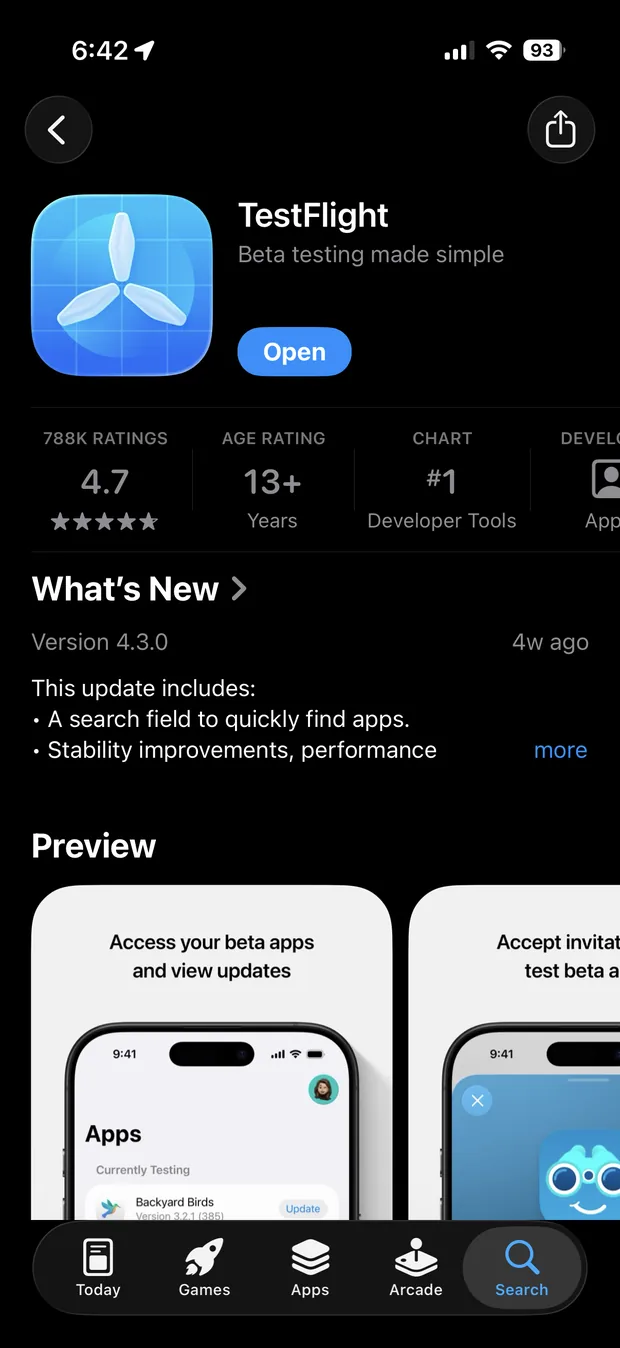
This is the one — a paper aeroplane, by Apple.
Once I add you, Apple sends an invitation. If it is not there, check your spam or promotions folder — it often lands in one of them.
This is the step most people miss. The link only works on the phone you want the app on.
The blue button is the one.
HEROMINUTES appears on your home screen like any other app. You open it from there from now on, not from TestFlight.
Answer the intake honestly — the programme is built from your answers, so a made-up answer gives you a made-up programme.
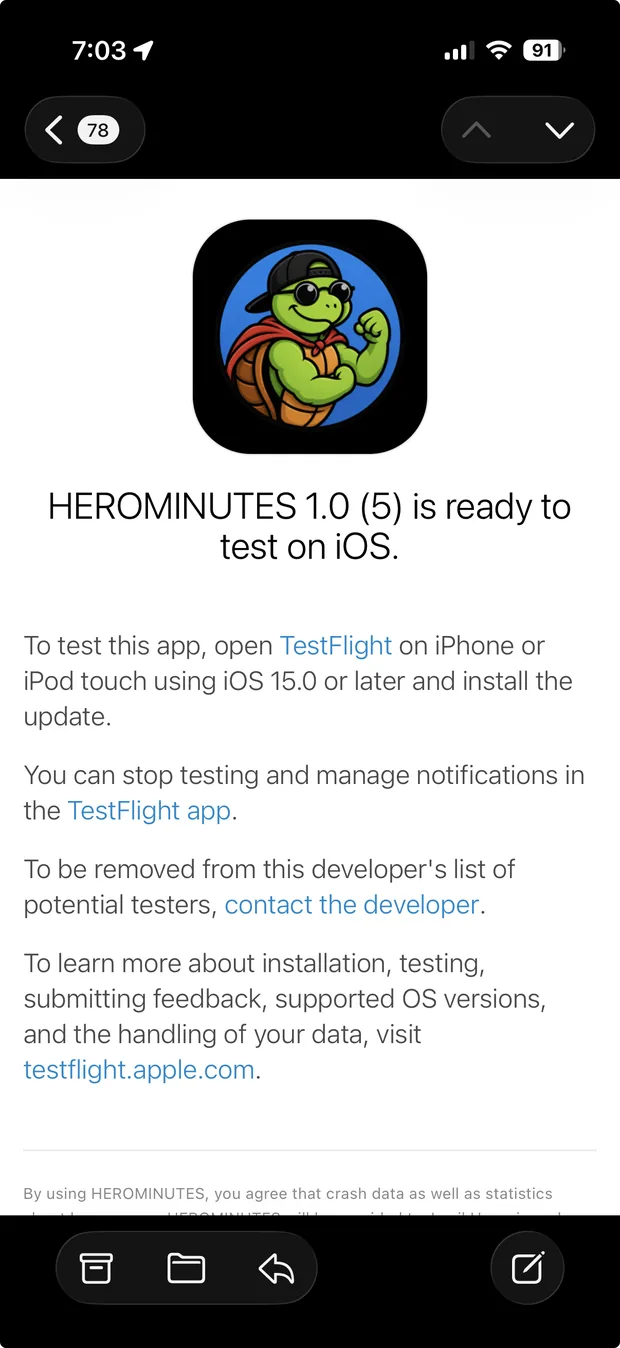
Every time there is a new version, Apple emails you. You do not go through any of the above again — just open TestFlight and tap Update.
Inside the app, take a screenshot the way you normally would. TestFlight offers to send it to me with a note attached — it is the easiest way to report anything, and I see exactly what you saw.
The app isn’t finished, and that’s the point. The group is small enough that I read every piece of feedback myself and reply to it.
Features get added, changed and cut based on what testers say. Several things in the app right now exist because a tester asked for them.
Once it’s on the App Store, it is what it is. Right now it’s still being decided — and you’d be one of the people deciding.
Free while we’re testing — no card, nothing to pay. Places are limited.
Stuck at any step? Reply to my email and I will walk you through it.
Most apps hand you the same plan whether you slept badly, tweaked a shoulder, or feel unstoppable. This one asks first.
A training app that works around a sore shoulder, a cranky knee or a bad back. Most flare-ups are not red flags, and it checks every one. When one is, it stops and points you to a professional.
Places are limited while we're in TestFlight. We'll reply by email.
Getting back to normal isn’t the goal when fitness is in your DNA.
Most fitness apps never ask how you feel today. They don’t slow down when something hurts or when you’re tired.
So you guess. Push through, or stop completely.
Then today’s session is written around your answer.
You don’t need to know what it is. Tell it where the discomfort is, and how much.
At 3 or under, you’re clear: the day counts toward your next phase. At 4 to 6, you get guidance for that spot, and the next session is written around it. At 7 or more, the session stops: it takes the load off, and tells you when to get it looked at.
Loads it less. Works what supports it.
It stops the session. Load comes off for three days, and it tells you when to get it looked at.
It asks for more.
Lighter, not skipped.
From setback to elite.
I injured my back, my neck, and my hip. I was told to expect a new normal, or surgery: no sport, no lifting.
I didn’t want a new normal.
I didn’t want surgery either — that’s my call, and yours is yours. What nobody helped with was the part after: getting back to training, around a body that felt different every day.
So I built it. My comeback.
— Jamil, Founder
Not mockups. These are real screens, with the numbers a real week produces.

Tap or hover a number on the screen.
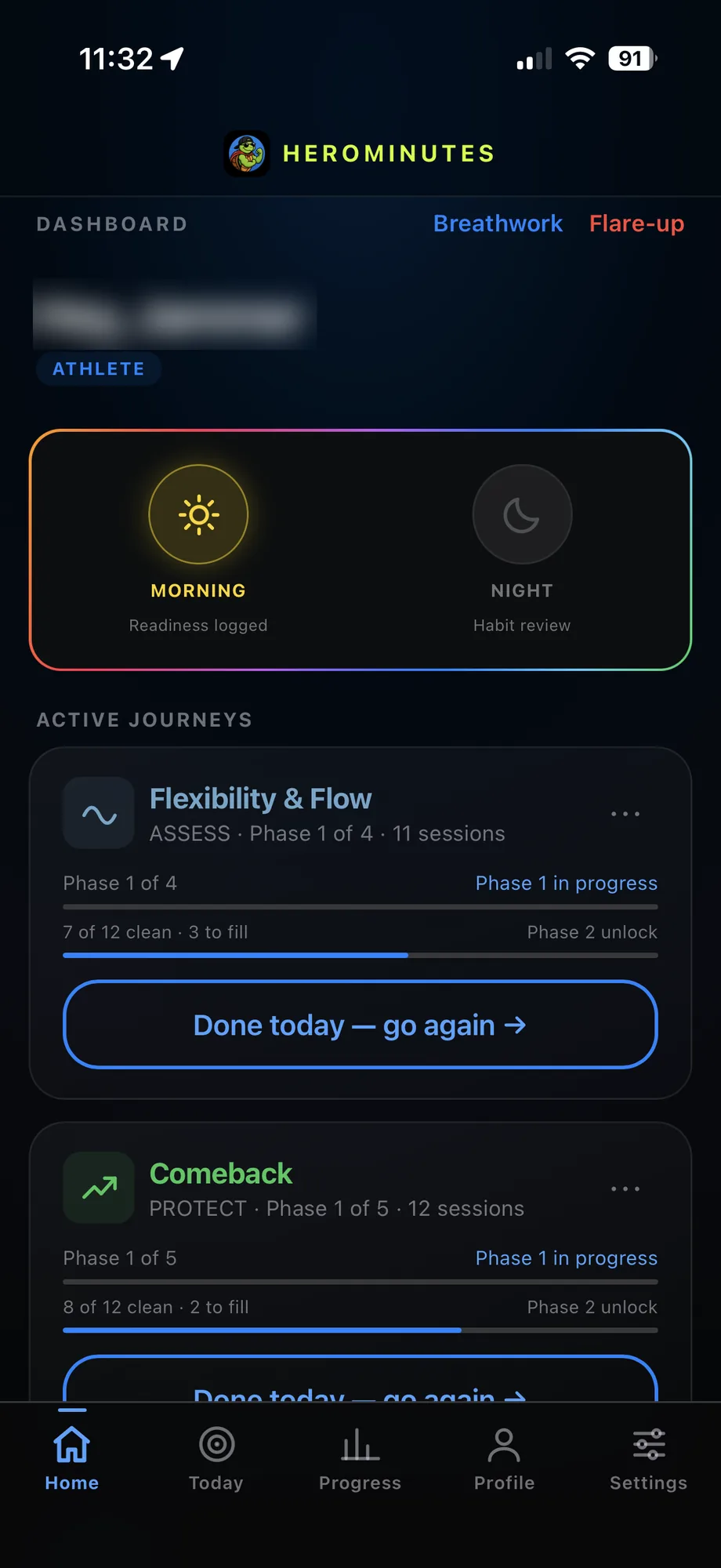
Two check-ins a day. Morning sets today's load before you train. Night reviews the habits underneath it — food, water, alcohol, sleep.
Journeys run side by side. Two at once on Athlete, each with its own phase and its own programme.
The phase gate is visible. "8 of 12 clean · 2 to fill" — you always know exactly what's left before the next phase unlocks. No hidden criteria.

Tap or hover a number on the screen.
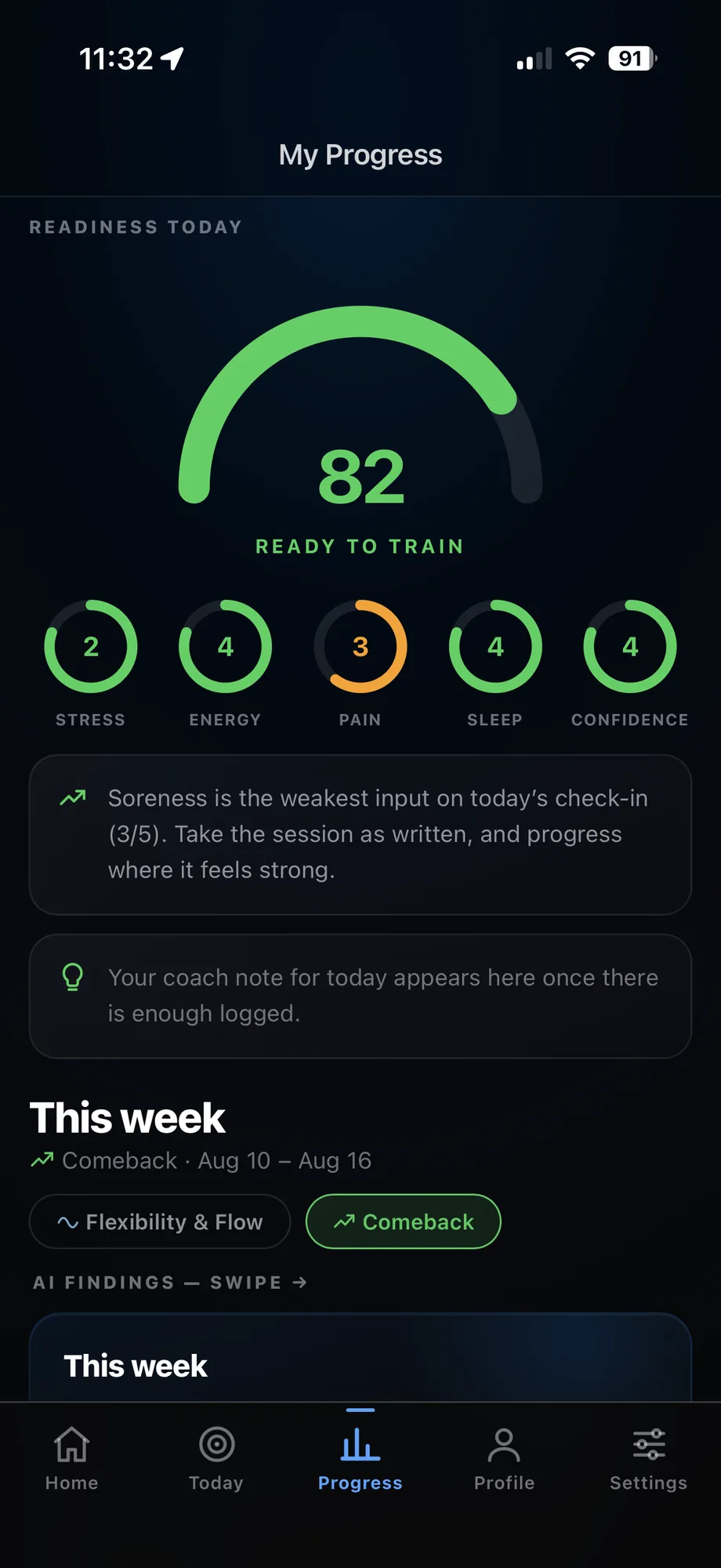
One number, five inputs. Your morning answers become a readiness score before you train — and the session is built against it.
You can see what's dragging. Stress, energy, discomfort, sleep and confidence, each scored. Anything off colours differently.
And what to do about it. One line of advice, aimed at your weakest input that day. Here it says: take the session as written, and push only where it feels strong.

Tap or hover a number on the screen.
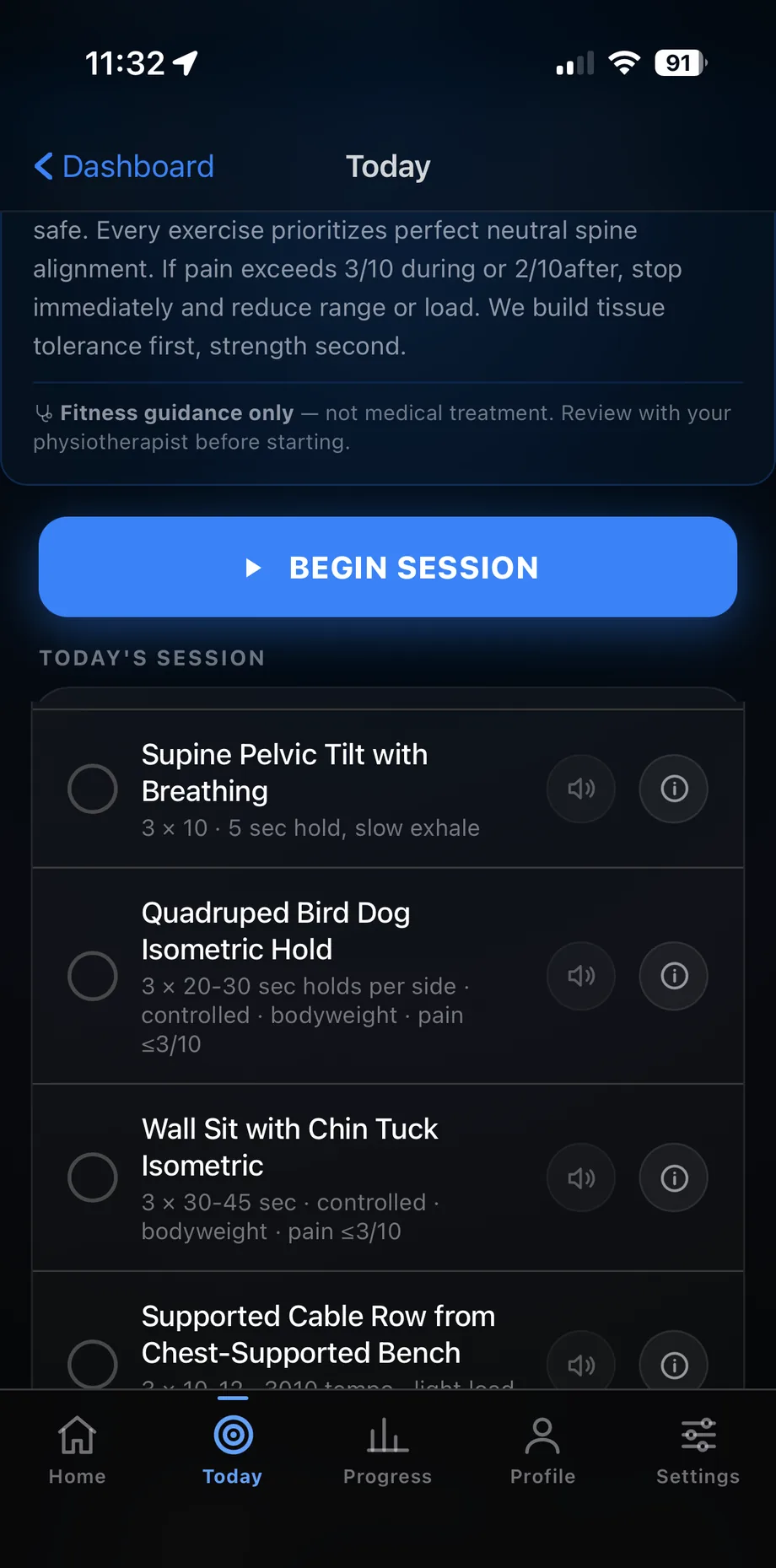
The safety line sits on the session, not buried in settings — fitness guidance only, and a prompt to check with your physical therapist first.
Begin starts the clock and Zeeva's welcome, with an estimate of how long the session should take.
Tap the speaker and she talks you through that exercise — the movement, the count, the rest.
Every exercise carries its dose. Sets, reps, tempo — and the coach note names a discomfort level to stop at. The programme tells you when to back off, not just when to push.

Tap or hover a number on the screen.
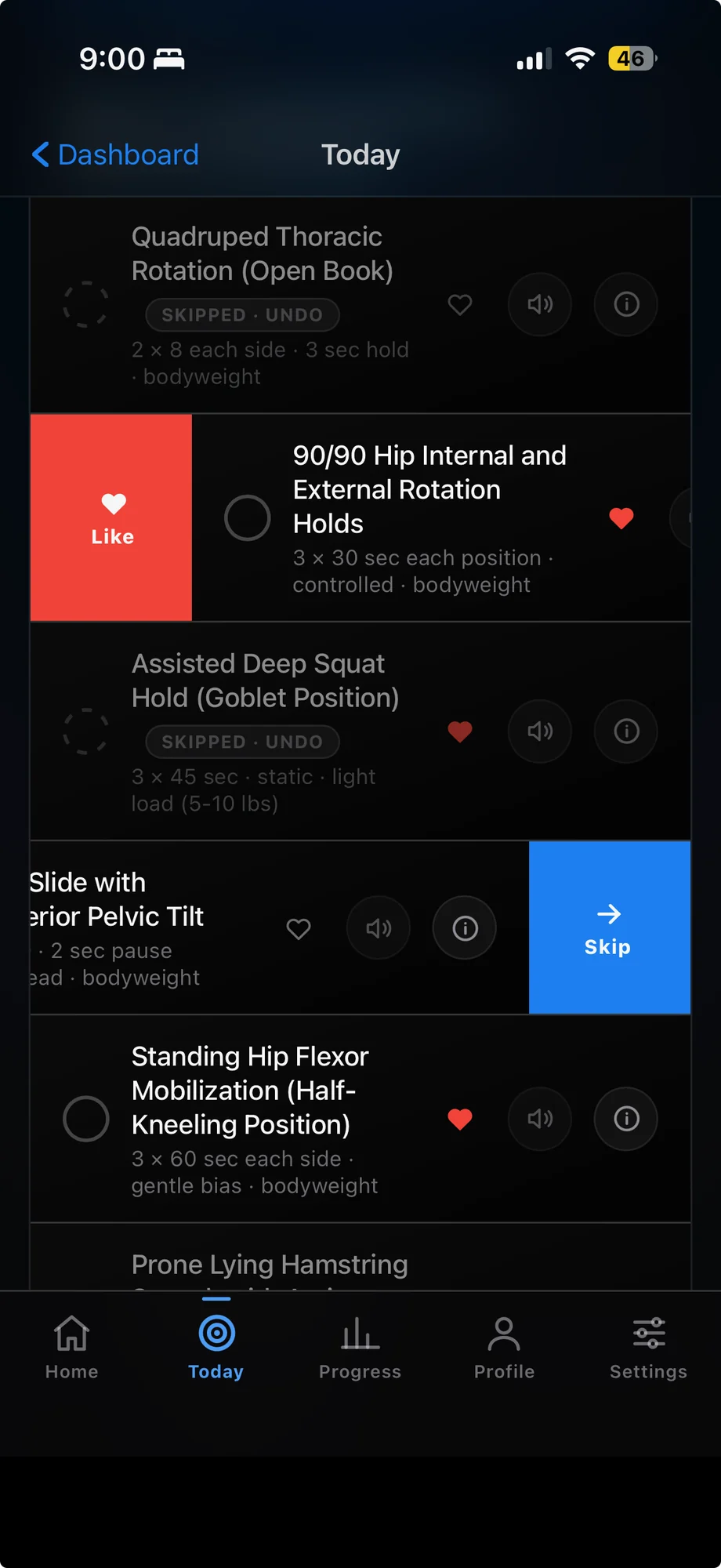
Two gestures, no forms. The programme gets better because you told it something true, not because you filled anything in.
Swipe right to keep it. A heart means you’d do this one again — it never changes what you’re given today.
Swipe left to skip. Sometimes you can’t do a movement. No kit, no space, or it just doesn’t feel right. Saying so honestly beats ticking it off.
It shapes the next phase, not this one. Your likes and skips go into the brief when your next phase is written — likes as evidence of what you’ll actually complete, skips as a constraint to work around.

Tap or hover a number on the screen.
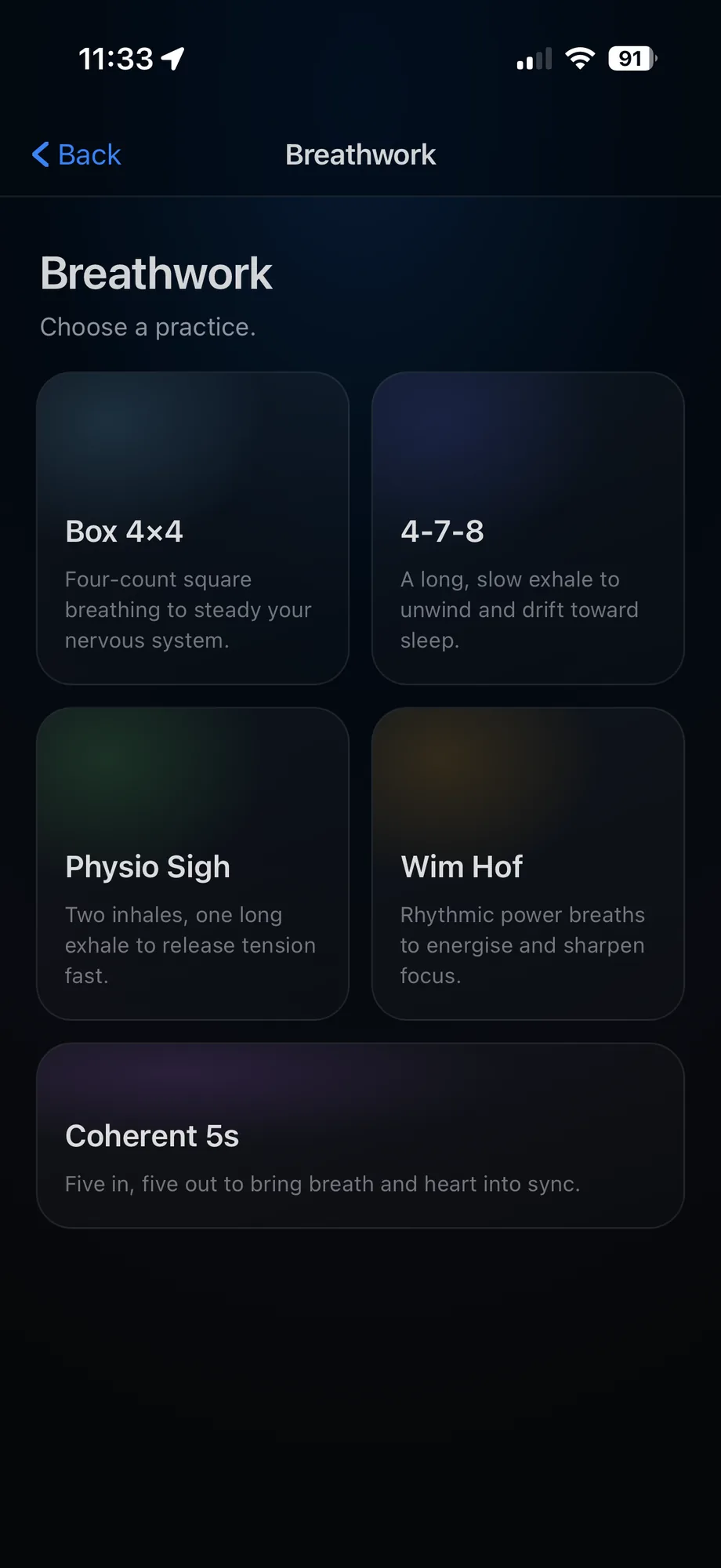
Five practices, chosen for different jobs. Guided with a visual pacer, so you follow the shape rather than count in your head.
Box 4×4 — four-count square breathing to steady your nervous system.
4-7-8 — a long, slow exhale to unwind and drift toward sleep.
Physio Sigh — two inhales, one long exhale, to release tension fast.
Wim Hof — rhythmic power breaths for energy and focus. Coherent 5s — five seconds in, five seconds out, for a steady rhythm.

Tap or hover a number on the screen.
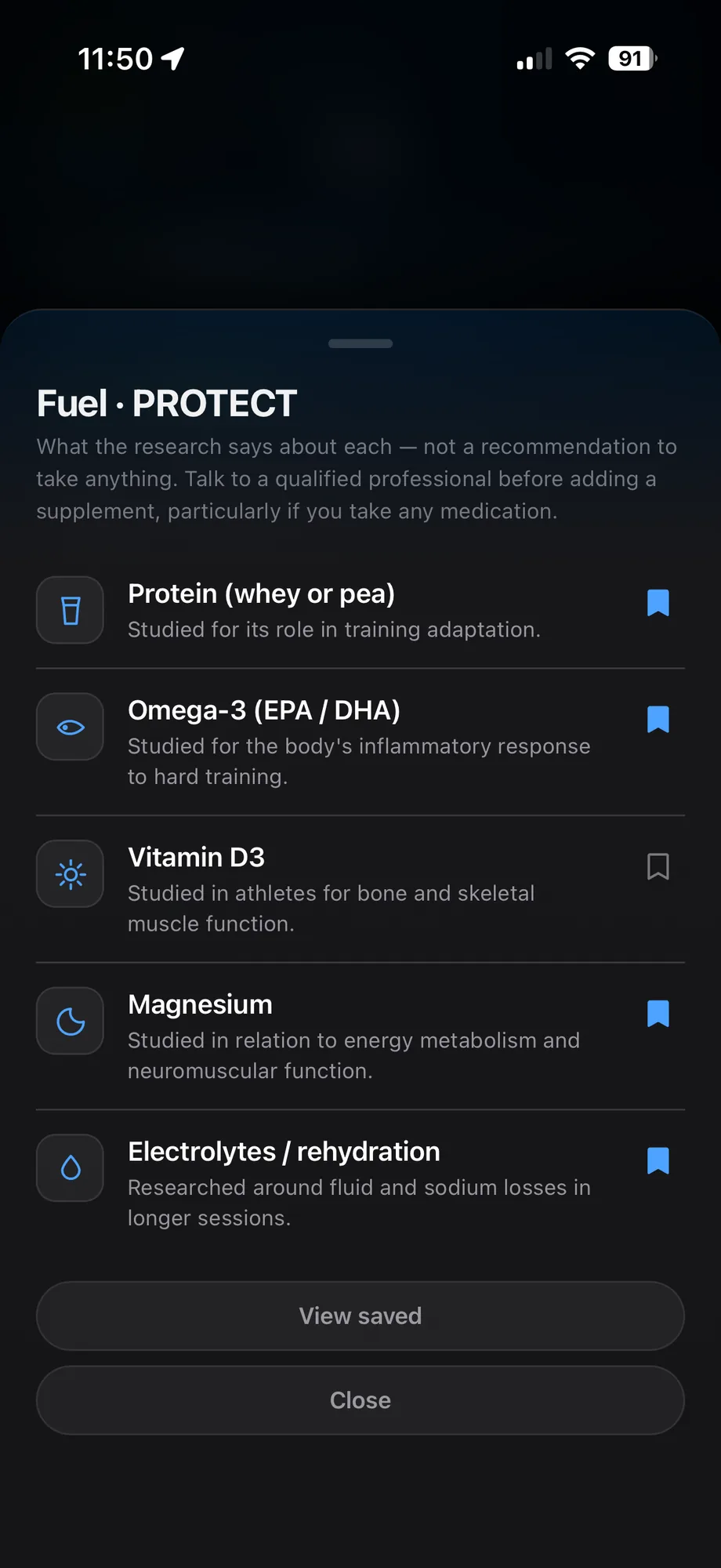
It says what it is, up front: what the research says about each one, not a recommendation to take anything — and a prompt to talk to a professional first, especially if you take medication.
Each entry says what it has been studied for — not what it will do for you. "Studied for its role in training adaptation" is a different claim from "this builds muscle", and the difference is the point.
Save the ones worth raising with your doctor or physical therapist, so the conversation starts from evidence rather than an advert.

Tap or hover a number on the screen.
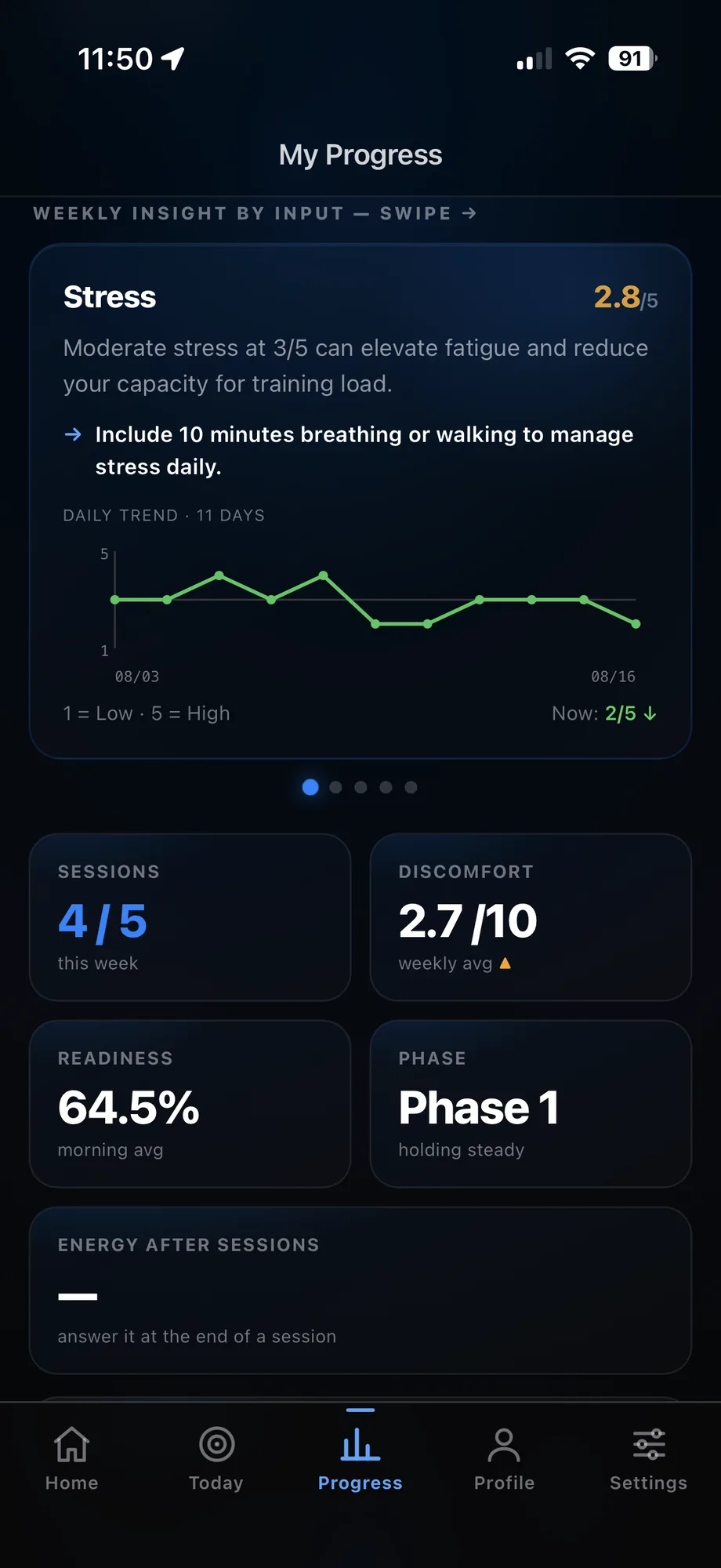
Every input gets its own weekly read, with one concrete thing to try — swipe through stress, energy, sleep, discomfort and confidence.
The trend behind the number. Eleven days of stress here, so you can see whether a bad day was a blip or a direction.
The week in four numbers — sessions done, average discomfort, morning readiness, and which phase you're holding. Enough to learn how your own body responds.
There's no catalogue to scroll, no plan to follow rigidly for twelve weeks, and no assumption that today is like yesterday.
Reads your check-ins, your discomfort trend and how the last sessions landed — then writes today's session around them.
Not one plan. A system that keeps running.
“Couldn't I just ask ChatGPT for a training plan?”
You could, and it would write you a good one. Once. Everything below is what happens after that — first at a glance, then in full, with each point linking to the part of the app that does it.
“Some” because a few fitness apps genuinely do it — this is what they do, not a scoreboard.
Every check-in, finished session, discomfort entry and phase review feeds the next programme it writes. Month three knows more about you than month one.
A chatbot starts from nothing every time.
See what it asks you ↓Phases unlock on your own reported comfort and consistency — your numbers, not a calendar. A bad week adjusts the plan instead of being ignored.
A chatbot gives you whatever you ask for, ready or not.
See the phase gates ↓Every session passes screening, programming and a safety check before you see it. If something you report needs a doctor or a physical therapist, it stops, tells you why, and sends you to see someone.
A chatbot is built to answer. It keeps writing sessions no matter what you tell it.
See the three steps ↓A coach who talks you through every exercise, breathwork that counts each breath, one-tap logging, streaks and a comeback story from what you actually did.
A chatbot hands you a wall of text between sets.
Hear the coach ↓You move forward when you've earned it — measured against your own numbers, not a calendar. Fall back and the app adjusts instead of pretending it didn't happen.
Settle things down and rebuild the basics, without stirring up whatever is sore.
Add weight and effort back slowly, checking after every session how you handled it.
Real strength work, built on a base that's proven itself.
Power, speed and the movements your sport actually asks for.
Training at full tilt, with the work that keeps you there instead of hoping you stay lucky.
Phase gates check your own reported comfort and consistency before unlocking the next one.
Two main journeys, each with its own checks and its own programme. Add a second and run both at once.
For training around something that's been bothering you. Five phases, built to keep you moving rather than waiting it out — and to stop and point you to a professional when that's the right answer.
For bodies shaped by a chair. Four phases of undoing what sitting all day does to you — and building back the strength it quietly takes.
Not a beep and a timer. She explains the movement in plain English, counts your reps, tells you when to rest and how long, and stays quiet when you don't need her.
Mid-set, roughly
"Set two. Twelve reps. Let's go."
One… and back to the start. Two… three…
Halfway. Nice and steady.
Good set. Rest for forty five seconds.
Back in. Three. Two. One.
Four moments, each feeding the next programme it writes. Answer them honestly and the sessions get more like you.
On the two main journeys your session isn’t written in one go. It’s built in three stages, each with a different job, and you only ever see the finished result.
If what you’ve reported looks like it needs a doctor or a physical therapist, the app stops there and tells you why. You get no session that day.
That’s the part worth understanding. A tool built to always give you an answer will always give you one, however you’re feeling when you ask. This one is built to know when not to.
No human reviews your programme. Here's exactly how the AI works — including what it can't do.
One tier during the beta. No upsells inside the app, and nothing locked behind a second purchase.
Founding testers who finish their first phase and share one piece of feedback keep a locked price when we launch.
HEROMINUTES is a general wellness app. It does not diagnose, and it is not a substitute for seeing a qualified professional. If something hurts more than usual, or sharply, stop. If you're working around an existing problem, talk to your doctor or physical therapist before you start — and if you report something that needs proper attention, the app will stop and tell you so rather than writing you a session.
Full disclaimerWe're adding testers gradually so we can read every piece of feedback properly.
A small product made in the open. Here is exactly what is done, what is happening now, and what has no date yet.
The whole product is written and running: adaptive programme generation, the check-in loop, discomfort logging, phased journeys, the voice coach, and the safety screening that sits in front of all of it.
It is a single-page app written in plain JavaScript — no framework — talking to serverless functions on Node.js, with Postgres underneath. Programmes are written by Claude in several passes; the voice is generated once per exercise and shared, never per person. The iOS app is that same codebase in a native shell.
Getting the app onto Apple's beta system: developer enrolment, the App Store Connect record, the first signed build, and the first internal testers.
About six months with a small group of invited testers. Small on purpose: everyone gets a real conversation, and at this size the interviews matter more than the numbers.
Feedback goes straight back into the build and out as a new TestFlight release — not one round, a loop that keeps running.
Public launch on the App Store. We launch when the beta says we should, not on a date. Three things have to be true:
A date is easier to publish and easier to miss. If the testing says it is not ready, it is not ready — and we would rather say that here than quietly ship something half-finished.
The app isn’t finished, and that’s the point. The beta is a small group — small enough that I read every piece of feedback myself and reply.
Features get added, changed and cut based on what testers say. Several things in the app right now exist because a tester asked for them.
Once it’s on the App Store, it is what it is. Right now it’s still being decided — and you’d be one of the people deciding.
Free while we’re testing — no card, nothing to pay. Places are limited.